
April 15, 2026 by Graham Merrington
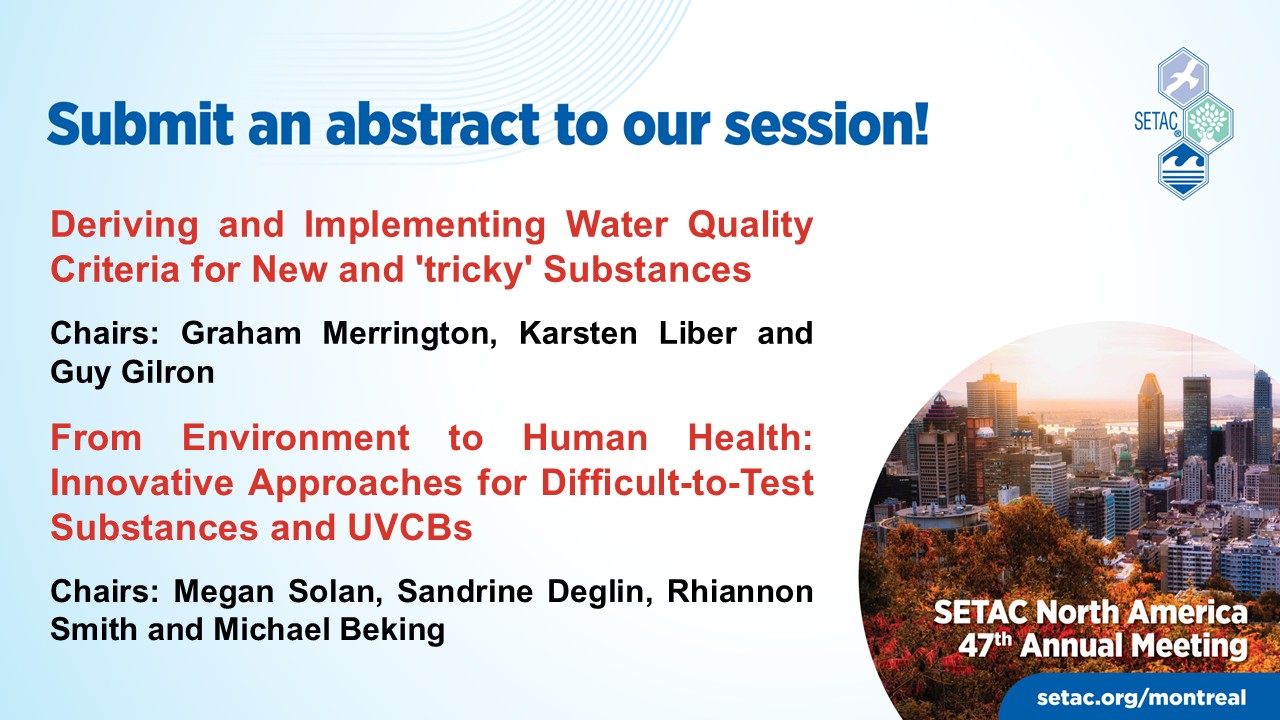
wca have had two sessions accepted for the SETAC North America 47th Annual Meeting being held from the 2nd to the 5th November in Montreal, Quebec:
- Deriving and Implementing Water Quality Criteria for New and ‘tricky’ Substances. This is in Session track: 7. Policy, Management and Communication. The Session chairs are Graham Merrington, Karsten Liber and Guy Gilron.
- From Environment to Human Health: Innovative Approaches for Difficult-to-Test Substances and UVCBs. This is in Session track: 1. Environmental (Human and Ecological) Toxicology and Stress Response. The Session chairs are Megan Solan, Sandrine Deglin, Rhiannon Smith and Michael Beking.
Please do submit your abstracts for platforms and posters; further information on the sessions is included below. Any questions please do contact us.
Deriving and Implementing Water Quality Criteria for New and ‘tricky’ Substances
Historically, substances identified as requiring Water Quality Criteria (WQC) derived were all well-known, data-rich, and their fate, behaviour and hazardous properties mostly understood. More recently, the process of WQC derivation, and especially their implementation (i.e., how the values are applied in practice), has changed considerably. These changes reflect: our increased understanding of environmental ‘hazard’ of chemicals; improvements in chemical analyses; and, perhaps also an increasing socio-political focus on surface waters. So, in addition to WQC for industrial chemicals, metals and plant protection products, environmental regulators are increasingly deriving values for human and veterinary pharmaceuticals, biocides, household and personal care products, and cosmetics, along with less-studied metals (e.g., rare earth elements (REE)) and radionuclides extracted from critical minerals.
Practitioners responsible for those derivations now face challenges, including: limitations in data, not just direct ecotoxicity data, but also for less-traditional endpoints such as endocrine disruption, and other sub-chronic endpoints. Data limitations may reflect ‘ownership’ issues but also include difficulties in analytics and testing (e.g., solubility, bioavailability).
Even after derivation and publication, implementing WQCs to deliver meaningful environmental improvement and refined aquatic risk assessments can still prove problematic. There may be challenges associated with measuring the substance in the appropriate matrix (e.g., biota or sediment), or in an appropriate chemical species and robustly assessing compliance limits using the WQC. This places additional monitoring and interpretation burden upon practitioners managing these data.
Protocols and guidance are developed to ensure scientific robustness, consistent derivation and implementation of WQC. Data limitations and information gaps are often dealt with in these documents, using safety factors to derive lower WQC (in Europe, British Columbia (Canada)) or the ‘labelling’ of the limit value in a way that ensures it is recognised as being of greater relative uncertainty (e.g., Australia, Canada).
This Session aims to explore various best practices and innovative approaches to assist practitioners in dealing with the challenges of WQC derivation and implementation for substances considered hazardous, but where data are limited and approaches lacking in existing guidance and protocols.
From Environment to Human Health: Innovative Approaches for Difficult-to-Test Substances and UVCBs
Difficult-to-test substances (DTS), characterized by properties such as low solubility, surface activity, sorption, rapid degradation, ionization, volatility, etc., represent a large fraction of the chemicals on the market. Substances of Unknown or Variable Composition, Complex Reaction Products, or Biological Materials (UVCBs), often comprise a large number of constituents, some of which may be DTS. Both DTS properties and, in the case of UVCBs, compositional complexity, pose unique challenges to characterization and testing, and hence to the assessment of their fate, exposure, hazard, and potential risks to human health and the environment. These challenges include experimental aspects such as dosing and concentration stability. In the case of UVCBs (e.g. essential oils, resins, surfactants, and petrochemicals), the wide range of uncharacterized constituents of varying compositions make it difficult to develop standardized approaches to support risk assessment. Traditional analytical approaches for characterizing DTS are not well-suited to assess these types of chemicals and lead to uncertainty in risk assessment and regulatory acceptance. OECD Guidance Document 23, which addresses aquatic toxicity testing of DTS, provides only minimal guidance on how to handle the specific challenges associated with UVCB substances.
This session aims to highlight the latest research addressing the challenges associated with risk assessment of DTS, including UVCBs. We also seek to explore how more traditional methods can be adapted to characterize these substances and other DTS properties. Presentations on approaches that have been employed to generate robust data on UVCBs presenting multiple DTS properties are of particular interest. We strongly encourage the submissions of illustrative, ground-truthing case studies from different industry sectors to stimulate the sharing of learnings. Topic areas of interest include in vitro dosing methods, adaptations of existing toxicity data, biodegradation testing strategies, and modelling approaches. The goal of this session is to enable sharing and drive convergence on optimal approaches for data-driven decision making in the hazard and risk assessment of UVCB/DTS substances.
From our blog
October 14, 2026 by Iain Wilson