
October 7, 2026 by Rhiannon Smith
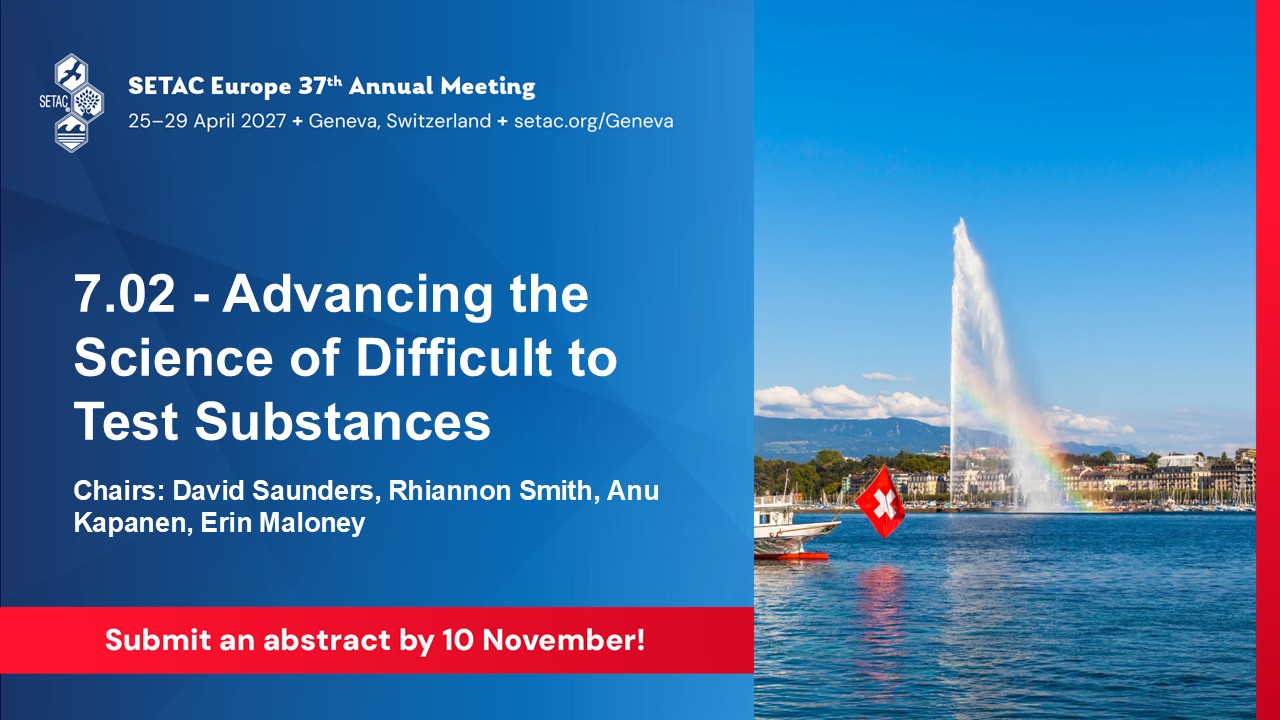
Following the interesting discussions on difficult to test substances at SETAC Maastricht, we are looking forward to exploring the subject further at SETAC Montreal in a few weeks. Further beyond that, we are also hoping to re-visit the themes covered and demonstrate progress at the SETAC Europe 37th Annual Meeting in Geneva, Switzerland on 25-29 April 2027). We are currently seeking abstract submissions for a session at this meeting.
Difficult to test substances (DTS) present unique challenges for environmental hazard and risk assessment due to properties such as volatility, low solubility, adsorption, rapid degradation, ionization, surface activity, and complex composition, including UVCBs. These characteristics can complicate exposure characterization, analytical verification, bioavailability assessment, and the application of standard testing methodologies.
The session proposed for SETAC Geneva in 2027 aims to bring together scientists from industry, academia, regulatory authorities, and contract research organizations to discuss:
- Scientific and regulatory challenges associated with assessing DTS;
- Successes and lessons learned from adapting or applying standard test methods;
- Emerging methodologies and technical innovations for generating and evaluating DTS data; and
- Future directions for robust environmental hazard and risk assessment of DTS.
We welcome a broad range of contributions, including:
- Experimental case studies;
- Method development and validation;
- Modelling and predictive approaches;
- Regulatory perspectives;
- Collaborative research initiatives; and
- Cross-sector experiences involving complex substances and challenging chemistries.
If you are working on topics related to difficult to test substances and are planning to attend SETAC Geneva 2027, we would be delighted to receive an abstract submission for this session.
Please also feel free to circulate this invitation within your networks to reach colleagues who may have relevant work to present.
If you would like to discuss the suitability of a potential abstract, please do not hesitate to contact me.
We hope this session will provide an excellent opportunity to advance scientific dialogue and share practical experiences in this important and evolving area of environmental assessment